- decision
Move Agent Hub's core experience to chat, so users express intent in language instead of navigating menus
- assumption: the belief that made me confident
GTM users at AEC firms will get to outcomes faster by stating intent than by learning a feature tree
- confidence at the time
- 70% · high
Agent Hub
A suite of agents GTM teams at AEC firms run to build and ship their documentation workflows: proposals, compliance checks, tagging, research.
Product Manager, AI Agents at KantivOpen the app →
the call I made
what it looks like
5
functions owned end-to-end
engineering, design, data, sales, client teams
2 wk
release cadence
what I did
At Kantiv I lead Agent Hub, where GTM and marketing teams at architecture, engineering, and construction firms run a suite of agents: proposal creation, compliance checks, document tagging, research, to ship their documentation workflows.
What I actually built
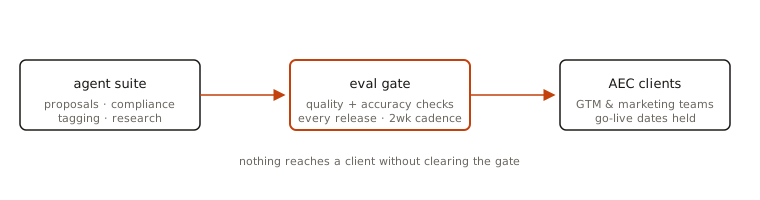
Two things here are mine in the direct sense. The eval release gate: quality and accuracy checks that agent outputs must clear before anything reaches a client, run before every release. And the UX revamp to chat: I led the move of the platform's core experience to a chat-based interface, so users express intent in language instead of navigating menus. That is the decision this page's record documents.
The operating texture
I own delivery end-to-end across five functions on a two-week release cadence, and run recurring customer interviews with AEC GTM teams to validate scope before it hits the roadmap. I also positioned the product as the system of record and execution layer for AEC GTM teams, and shaped pricing for the agent suite around how teams land and expand usage.
what happened
Not yet evaluated. This one is still open.
▸ the full record: evidence, alternatives, risks, what I traded away
- risks I named
- Chat can hide capabilities: discoverability loss for everything users don't think to ask for
- Free-form intent raises the bar on agent reliability before every release
- how I'd know it worked
Users reach their primary workflows through language without falling back to menu hunting
what I knowingly traded away
- Chat-first over menu-first: traded discoverability for speed of intent, then mitigated with suggested actions
- Evals as a hard release gate: slower releases, but agent output that reaches AEC clients is checked, not vibes
- Pricing shaped around how teams land and expand rather than per-seat simplicity
built with: Agent orchestration · Evals as release gates · Chat-based UX